by Kaley Hutter, MFA ’27
We often measure MFA alumni success by lines on a CV: publications, jobs, awards. These things matter, of course, but what about the less obvious ways an MFA can prepare the path for a sustained artistic practice? When I decided to apply, my own list of quiet-yet-vital provisions included a few years of active writing community. However, I’ve learned that this community doesn’t stop after the two-year program; in fact, for some Hollins alumni, it’s still going strong after almost a decade.
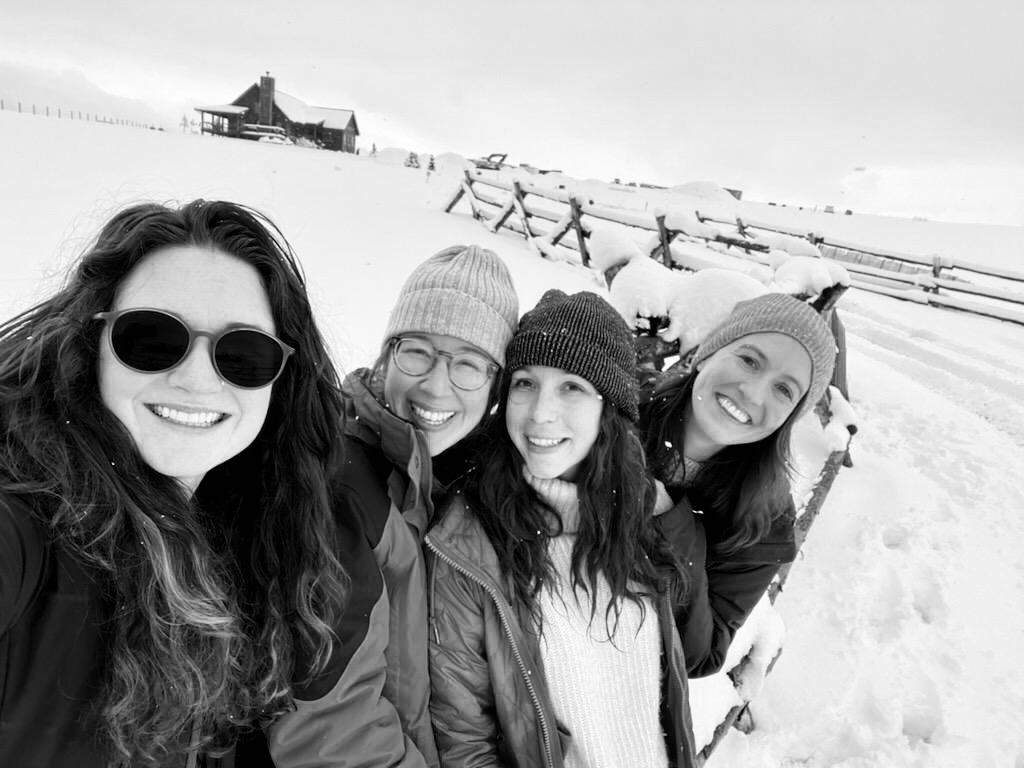
Since graduating from the Hollins MFA in Creative Writing Program in 2017, Ellie Paolini, Inga Schmidt, Abbey Tippin, and Tessa Cheek have virtually gathered almost every month for workshop. The key to the practice, Inga shares, is flexibility—that’s what makes this postgrad community last, being able to work around each other’s developing lives and have grace for each other when the writing runs dry.
In the past year, two of the group have submitted entire novel drafts for workshop—a milestone both say wouldn’t have been possible without the care, accountability, and longevity of their postgrad community. “We are in Hannah Arendt’s agora,” Tessa says. “We shape each other.”
As a first-year in the MFA, I got to spend time with Ellie, Inga, Abbey, and Tessa over Google Meet in mid-February, before their monthly meeting time.
The following conversation has been edited for length and clarity.
How has your writing practice changed or adapted in the years since post-MFA, and how has this group affected it?
Tessa: I would say that this is a huge reason why I still write. I’ll speak for myself here, but I had never experienced writer’s block before, and right after the MFA, I hit a really bad wall. I didn’t write really much at all for years, except small things. It’s really hard figuring out how to hold a job and a creative writing practice and still have any kind of accountability. Ellie and I were in tutorial with Karen Bender, and I remember one of the things she said to us was that part of making it as a writer is just to write. You wouldn’t believe how many people give up or stop. There were many years where I didn’t feel like a writer, and I felt so far away from my craft and practice, and having this touchstone was so important. It kept me in the game.
Ellie: For me, it’s helped me keep up with my identity as a writer, as a person who loves words. In my personal life, I’m not surrounded by people who love, love, love to talk about writing like we did in the program. That was where I found my people, and these are my people still. We always touch base about what we’re reading, and what we’re working on, and how we see those things through a writerly lens. I feel like myself in a different way with this group than when I’m in the world on an everyday basis.
Abbey: When I started my MFA, I wanted to be around people who were better writers than me because I knew that would make me a better writer. And I’m so grateful—Inga, Ellie, and Tessa are the smartest people I know, and the best writers I know. And it’s so nice to always have this time together. And the writing does ebb and flow.
What kinds of projects have you worked on with/brought to the group?
Ellie: We’ve all worked on at least one long-term project in the group. It’s nice to have the same readers, the same sets of eyes on it, knowing that they’ll approach it with such generosity and keep in mind the aim we’re trying to achieve.
Inga: Something that I love, as a person who writes poetry, is being in a workshop of people who write fiction and getting that different perspective on my work. It was one of the reasons why I went to Hollins—I like that it’s cross-genre, and you get to dabble in other things, and you can workshop with different people.
Tessa: And I think that distance strengthens different muscles in our writing.
What do you see as the value of creative community for a writer?
Ellie: I think that the biggest gift of Hollins is your workshop. I remember one professor one day looking around in workshop and saying, “This is the most important thing you’ll get out of this”—the relationships. She made the point that we were all writers, we’d figure out how to write, but this was the thing the MFA program is all about. That really stuck with me.
Inga: And it feels unique to Hollins. The fact that Hollins encourages discussions like that was very important to me.
Tessa: Yes, I think it’s a testament to the overarching pedagogy at Hollins that we were encouraged to build each other up. I have dear friends who went to other MFAs who hated everyone in their program, or it was just so fearfully competitive that you would never show someone drafts at the stage that we show each other, or give the feedback that we give each other. I’m just so incredibly grateful that we got that rich community in our pedagogy. I wouldn’t say that we’re competitive, but we are in Hannah Arendt’s agora; we shape each other. When Abbey turned in a full draft of her novel, I was like, I need to get it together. It inspired me. I saw her do that, and I was like, I want to do that too!
Ellie: The community you have is everything.
How did your time at Hollins create the foundation for the community you’re still investing in?
Abbey: On some level, it’s that there was a generosity towards each other. It really was a place where everyone was generous with the work.
Inga: I would say something similar. There was an effort to be inclusive and not shut down what people are trying or what kind of work it is. When someone presented work, things began with, where are they coming from? It started with an open eye instead of a critical eye, which is something that’s so powerful to me. In workshop, it was like, think about what you’re doing—why are you doing that—instead of offering small critiques about what needs to change. The writer was encouraged to do more of that.
Tessa: It was truly a program that was about locating and honing your particular writing voice, as opposed to doing it “the right way.” I came up through a lot of craft workshops where there was a “right way” to do it, whereas Richard [Dillard] wanted us to get about ten times weirder than we thought we possibly could. There was so much faith in that kind of world and the good it would evolve into. It felt sacred.
What advice do you have for writers trying to make the most of their MFA?
Inga: To get the most of your MFA—from our experience—talk to each other. Take the opportunity to know the people in your cohort. You can learn so much from the people who are there next to you. Use the resources that are offered, especially with the visiting writers. Anything like that. Don’t miss out on your peers. That’s really important.
Ellie: In that vein, I’d say go to office hours just to hang out with your professors. There’s so much value in just building that relationship. Especially the visiting writers. I remember Tom Drury was our visiting writer one spring, and I remember one day coming into his office hours, and he was like, “Oh thank God, someone’s here! I’ve been sitting here the whole time.” And I thought—I haven’t been taking advantage of his presence here. Just for anything, stay as long as you can. I think I laughed harder at Hollins, with the people there, than I have in other parts of my life.
Tessa: Get up into the pasture. Pretend you’re Annie Dillard!
Abbey: My advice—that I need to take too—is that as you’re progressing as a writer, don’t be so hard on yourself as you grow. You’re going to be better from this.
What advice do you have for writers outside or past the MFA who don’t have a built-in community?
Abbey: I would say read! I know that for me, when I read a lot, it’s much easier to write.
Tessa: I lived in a really small town after Hollins. And whether or not you have an MFA, if the community isn’t there, you can build it. It’s actually okay to go to local bars and coffee shops or the library and ask, “Hey, can I start something here?” You can do that. Even if you don’t have an MFA. It’s okay. Host a free writing workshop. Go for it. I did that in my small community, and people really showed up and were excited about it, and they were cool and different and weird. Wherever you are, there are other people who are dying for this kind of stuff right now.
 Hollins MFA